Egli è un martire, con manto rosso, che attraversa l'acqua, sostenendosi su un albero-bastone, venerato dalla chiesa cattolica e ortodossa. Cristoforo, dal greco “portatore di Cristo”, suggerisce che con l'avvento di Cristo, l'uomo non è più responsabile del proprio piccolo mondo, ma di tutto il creato.
venerdì 14 febbraio 2014
San Cristoforo
Egli è un martire, con manto rosso, che attraversa l'acqua, sostenendosi su un albero-bastone, venerato dalla chiesa cattolica e ortodossa. Cristoforo, dal greco “portatore di Cristo”, suggerisce che con l'avvento di Cristo, l'uomo non è più responsabile del proprio piccolo mondo, ma di tutto il creato.
Chapter House
In the former convent annexed to the church
of St. Nicholas, it is situated the famous Hall of the chapter, where you can
admire the cycle of the Dominicans, work
that has allowed us to know and appreciate the artist Tommaso da Modena . The
frescoes are placed under the wooden ceiling, below a band of decorative
foliage, and they cover three walls and part of the fourth , where in the
middle is depicted the Crucifixion .
The cycle has a representation of 40 famous people of the Dominican
Order ,and it was painted between 1351 and 1352, as reported by an inscription underlying
, which unfortunately today is greatly ruined. Among the figures also stand out
personalities such as Pope Innocent V , Benedict XI , Cardinal Annibaldo
Annibaldi , and also St. Dominic , St. Peter Martyr and St. Thomas Aquinas .
The Dominicans are represented in their cells, which all converge
towards the scene of the Crucifixion , to emphasize the intense meaning of the
painting. The characters are all depicted in performing typical tasks of the
scholar , for example writing or reading.
The cells are constituted by two wooden walls which are welded together
by a writing desk , with a awning in the background , pomegranate-colored or
green. And it is the colour, rather than the perspective to create a third dimension
in the fresco . Moreover it si very pronounced the boundary line that
accompanies the different figures .
A key figurative element is the hat , which makes us understand the role
of the Dominican portrayed.
Each figure has different characteristics ,from the age to the
appearance of the face, and the expressions of the faces are exactly the ones,
so varied and realistic , to draw the public's attention.
In addition, the artist enlivens the different scenes by adding various
details , never seem before , such as glasses or a magnifying glass .
A common feature of these paintings is the description in detail of
reality, and the uniqueness of the characters given by the facial features ,
which are probably drawn from life.
The room was partly damaged during an air raid in 1944 , but despite
this, the frescoes were recovered and restored .
Sala Del Capitolo
Nell’ex convento annesso
alla Chiesa di San Nicolò è ubicata la famosa Sala del Capitolo, dove si può ammirare il ciclo dei Domenicani, opera
che ha permesso di conoscere ed apprezzare l’artista Tommaso da Modena. Gli
affreschi sono posto sotto il soffitto ligneo, al di sotto di una fascia
decorativa a fogliami, e ricoprono tre pareti e parte della quarta, dove al
centro è raffigurata una Crocifissione.
Il ciclo presenta una
rappresentazione di 40 personaggi illustri dell’Ordine Domenicano, fu pitturato
tra il 1351 e il 1352, come riporta un’iscrizione sottostante, che purtroppo
oggi risulta notevolmente rovinata. Tra le figure spiccano anche personalità
importanti, come ad esempio Papa Innocenzo V, Papa Benedetto XI, il cardinale
Annibaldo degli Annibaldi, e anche san Domenico, san Pietro martire e San
Tomaso D’Aquino.
I domenicani sono
rappresentanti all’interno delle loro celle, che convergono tutte verso la
scena della Crocifissione, per sottolinearne il profondo significato. I personaggi
sono tutti raffigurati nello svolgere attività tipiche dello studioso, come
scrivere o leggere.
Le celle sono costituite
da due pareti lignee che sono saldate assieme da uno scrittoio, con una tenda
nella sfondo, di colore rosso granato o verde. Ed è il colore, piuttosto che la
prospettiva a creare una terza dimensione nell’affresco. Inoltre molto marcata
è la linea di contorno che accompagna le diverse figure.
Elemento chiave figurativo
è il cappello, che ci fa capire il ruolo del domenicano ritratto.
Ogni figura, presenta
caratteristiche diverse, dall’età alla fisionomia del volto, e sono esattamente
le espressioni dei volti, così varie e realistiche, ad attirare l’attenzione
del pubblico.
Inoltre l’artista
vivacizza le diverse scene aggiungendo diversi particolari, mai rappresentati
prima, come per esempio gli occhiali o la lente d’ingrandimento.
Caratteristica comune di
questi affreschi è la descrizione nel dettaglio della realtà, e la unicità dei
personaggi data dai tratti fisionomici, che sono probabilmente tratti dal vero.
La sala fu in parte
danneggiata durante un bombardamento aereo del 1944, ma nonostante ciò gli
affreschi furono recuperati e restaurati.
Church of St. Nicolò, history and architecture

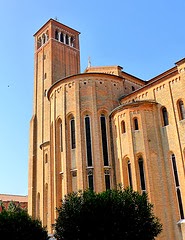
The Church of San Nicolò (St. Nicholas) is located in the south western part of the historic center of the city of Treviso and is the largest religious building in the city.
The construction of the church started around 1230, however the building was interrupted, first by the collapse of the bell tower and then by the plague that spread in the city in the first half of 1300.
The church belonged to the Dominican friars, and in the convent annexed to the building, began his religious education Bocassino Nicholas , who later became Pope Benedict XI.
The church shows a typically gothic style , because of its simple and massive shapes, with a brick covering on the outside , and it is at the same time elegant and with an upward projection , symbolic element of Gothic art .
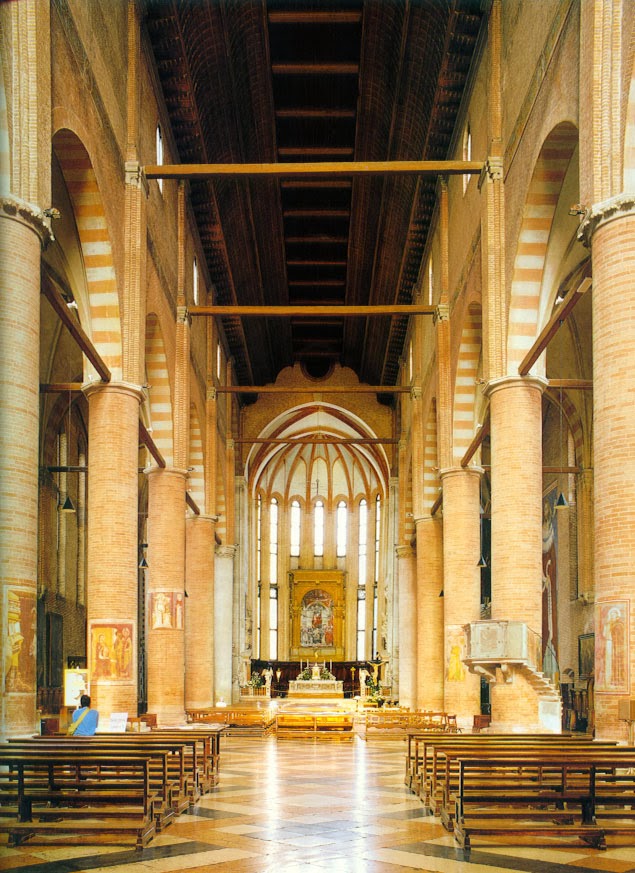
The plan is a Latin cross , and it is divided into three naves by twelve columns . To every aisle correspond a Gothic apse , particularly slender , with lots of very tall, narrow windows between the thin ribs. In the middle one, there is a painting depicting the Madonna Enthroned With Angel Musician and Saints. In the chancel there is the funeral memorial of Augustine Onigo.
The columns , which have the function of supporting the simple wooden fairing ceiling, report the frescoes by Tommaso da Modena , representing St. Jerome, St. Agnes and St. Romuald .
Down the right aisle, slightly raised , it is located a majestic organ of Gaetano Antonio Callido , and near of it, there is an imposing fresco of St. Christopher that comes almost to the trusses.
Chiesa di San Nicolò, storia e architettura
La Chiesa di San Nicolò è situata nella parte sud occidentale del centro storico della città di Treviso ed è il più grande edificio religioso della città.
Le costruzioni della chiesa iniziarono intorno a 1230. L’edificazione fu però interrotta prima dal crollo della torre campanaria e poi dalla peste che colpi la città nella prima metà del 1300.
La chiesa apparteneva ai frati domenicani e nel convento annesso all’edificio iniziò la propria formazione religiosa Nicolò Bocassino, che diventò in seguito Papa Benedetto XI.
La chiesa presenta uno stile tipicamente gotico, date le sue forme semplici e massicce, con un rivestimento in mattoni nella parte esterna, ed è allo stesso tempo elegante e con una proiezione verso l’alto, elemento simbolo dell’arte gotica.
La pianta è a croce latina, ed è divisa in tre ampie navate da dodici colonne. A ciascuna navata corrisponde un’ abside gotica, particolarmente slanciata, con tante finestre molto alte e strette fra nervature sottili. In quella centrale è presente una tavola raffigurante La Madonna in Trono Con Angelo Musicante e Santi. Nel presbiterio si trova il monumento funebre di Agostino Onigo,
Le colonne, che hanno la funzione di sostenere il semplice soffitto ligneo carenato, riportano gli affreschi di Tommaso da Modena, che raffigurano San Girolamo, Santa Agnese e San Romualdo.
Lungo la navata di destra, leggermente sopraelevato, è collocato un maestoso organo di Gaetano Antonio Callido, e a fianco si trova un imponente affresco di San Cristoforo che arriva fin quasi alle capriate.
mercoledì 12 febbraio 2014
Iscriviti a:
Post (Atom)